Open enrollment on Georgia Access runs Nov. 1 through Jan. 15. Our free Health Insurance 101 guide and enrollment team can help you find coverage that fits your budget.
If you buy your own health insurance, mark your calendar now. Open enrollment on Georgia Access runs Nov. 1, 2026, through Jan. 15, 2027. It is the one time each year most Georgians can sign up for a plan, switch plans, or make sure the coverage they have still fits their needs and budget. To have coverage start Jan. 1, enroll by Dec. 15.
This year, a little extra planning will go a long way. Unlike past years, there is no window-shopping period, so you won’t be able to preview 2027 plans and prices on GeorgiaAccess.gov until open enrollment begins Nov. 1. Plan to set aside time once it opens. Most insurers have proposed premium increases of more than 20%, the second year in a row of double-digit hikes.
Those costs have already pushed many of our neighbors out of coverage. About 1.3 million Georgians had a Marketplace plan last fall. By September, that number had fallen to roughly 900,000, after the enhanced premium tax credits expired at the end of 2025. Going without health coverage may seem like a way to save money, until an emergency room visit or unexpected diagnosis leaves you with a bill you cannot afford.
The good news: you don’t have to figure this out alone, and you may have more options than you think. Our Certified Application Counselors offer free, one-on-one help to Georgians shopping for coverage. Here’s how that help made a difference for one Georgian.
How One Update Took Maya’s Premium From $780 to $0
Earlier this year, Maya learned her monthly premium had jumped from $18 to $780. As a self-employed worker, she could not absorb that kind of increase, and she thought she had lost her only affordable option.
Instead, she reached out to GHF for help. Our enrollment assister walked her through which documents she would need to verify her income. As they reviewed her application together, they spotted the problem: the income listed no longer reflected her current situation.
Once Maya updated her income, she qualified for about $580 a month in financial assistance. She enrolled in a plan with a $0 monthly premium and added dental coverage for less than $9 a month. Today, she has coverage she can afford and can get the prescriptions she needs without worrying about the cost.
The name in this story has been changed to protect the client’s privacy.
Maya’s story is a reminder of two things. First, the information on your application matters. Before you shop this year, update your Georgia Access application so your income reflects what you expect to earn in 2027. A small change can make a big difference in the help you qualify for.
Second, you don’t have to sort it out alone. Terms like premium, deductible, and out-of-pocket max can make the process feel overwhelming. A trained, unbiased counselor can catch issues you might miss and help you find a plan that fits your budget.
If you miss open enrollment, you may still be able to sign up during a Special Enrollment Period after a major life change. These changes may include losing other coverage, getting married, or having a baby. And Georgia Medicaid and PeachCare for Kids accept applications year-round through Georgia Gateway.
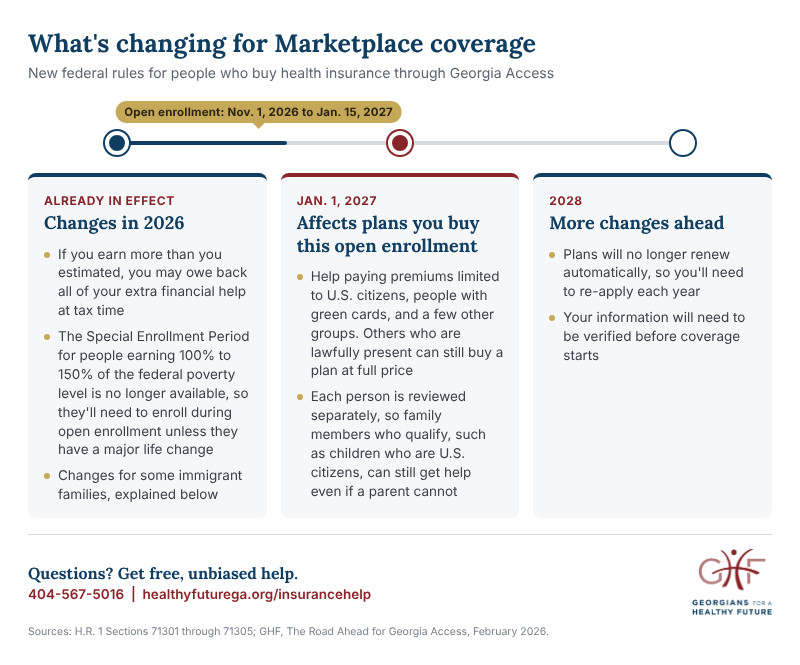
What’s changing for Marketplace coverage
A federal law passed in 2025, H.R. 1, is changing how Marketplace coverage works. Some of these updates are already in place. GHF projects they will cause 120,000 Georgians to lose Georgia Access coverage by 2034. Here’s what to know as you shop.
Changes already in effect
Repaying help at tax time. Your financial help is based on an estimate of what you will earn. If you end up earning more, you now have to pay back the full difference when you file your taxes. Before, the amount was capped based on income.
No more year-round sign-up for people with lower incomes. People earning 100% to 150% of the federal poverty level can no longer enroll in coverage any month of the year. Open enrollment is now the main chance to get covered.
Less help for immigrants with the lowest incomes. Since Jan. 1, 2026, lawfully present immigrants with incomes below 100% of the federal poverty level who are ineligible for Medicaid because of their immigration status no longer qualify for Marketplace financial assistance.
Changes for some immigrant families.New federal rules are also changing who can get help. As of Oct. 1, 2026, many immigrants with legal status, including refugees and people granted asylum, can no longer get Medicaid or PeachCare for Kids. Starting Jan. 1, 2027, financial help for Marketplace plans will be limited to U.S. citizens, lawful permanent residents (green card holders), Cuban and Haitian entrants, and COFA migrants. Refugees, people granted asylum, and people with temporary protected status can still buy a Marketplace plan, but only at full price. These rules apply person by person, so children and other family members who qualify can still enroll even if a parent cannot. If you are not sure how these changes affect your family, our counselors can help you sort through your options for free.
What this means for you
Accurate, up-to-date information on your application matters more than ever. If your income changes during the year, report it to Georgia Access right away so you don’t face a large bill at tax time. This is especially important for gig and seasonal workers, people who pick up a second job or get a raise mid-year, and households where a spouse returns to work. Not sure where you stand? Our counselors can walk you through your options for free.
Looking ahead: Starting in 2028, plans will no longer renew automatically, and you will need to verify your information each year before your coverage starts. Learn more in our brief, The Road Ahead for Georgia Access.
Our Certified Application Counselors offer free, unbiased help to individuals, families, small businesses, and their employees looking for coverage through Georgia Access.
Open enrollment starts Nov. 1. Download the guide today, share it with someone who buys their own coverage, and reach out when you’re ready. We’ll help you find a plan that works for you.
Georgia residents have some of the highest medical debt in the country, and it could get worse
Ellen Eldridge
LISTEN: On average, Georgia has twice as much medical debt than the rest of the country, according to Georgians for a Healthy Future Executive Director Laura Colbert. GPB’s Ellen Eldridge…