Peach Pulse Archive 2026

What’s Inside This Month’s Peach Pulse
Here’s what’s inside this month’s Peach Pulse:
- Meet Our New Leadership Team Members: Join us in welcoming Shanae Lee, Director of Finance and Operations, and Jennifer Ratner, Director of Development & Communications, to the GHF team.
- Coming in May: Getting Georgia Covered: Our spring giving campaign kicks off May 13. Watch for our kick-off email, or make an early gift today to power our enrollment assistance work.
- Read, Reflect, Act: GHF’s Latest Publications & Resources: This month, we’re sharing:
- A new interactive dashboard tracking how Georgia insurers are meeting their mental health parity obligations
- For Medicaid Awareness Month: Cover Georgia’s latest blog on why Medicaid works, what’s at risk, and how Georgia can strengthen coverage for more families
- A new hotline where Georgians can share how rising premiums are affecting their lives
- The 2026 Legislative Session is a Wrap: Sine Die has come and gone. Get caught up on the FY27 budget deal, bills that passed (and the ones that didn’t), and what to watch for as Governor Kemp’s May 12 signing deadline approaches.
- GHF in the News: Recent coverage from WABE, GPB, CNN, Atlanta Business Chronicle, and more!
Meet the Newest Members of the GHF Leadership Team
GHF is excited to welcome two new leaders to our team who will help us expand our reach, sharpen our advocacy, and keep showing up for Georgians across the state.
Jennifer and Shanae each bring excellent professional experience and deep commitment to this work. At a time when our communities are facing real threats to their health and coverage, our team is grateful for the extra capacity and skills that these two are adding to our advocacy.
|
|


Please join us in giving Jennifer and Shanae a warm welcome to the GHF Team.
Coming May 13th: Getting Georgia Covered Campaign

Georgians have faced major shifts in health coverage over the past few years. From the Medicaid unwinding to rising premiums, a lot has changed. For many families, figuring out what comes next is not easy.
GHF’s enrollment assister has been there for Georgians by answering their questions, explaining options, and making sure families do not have to navigate a complex system alone. GHF is one of the few organizations in Georgia that helps guide Georgians through enrollment in both Medicaid and Georgia Access marketplace coverage.
On May 13th, we are launching our Getting Georgia Covered spring campaign to support this critical work. Keep an eye out for our kick-off email on the 13th. If you are ready to give now, you can get a head start at gagives.org.
Read, Reflect, Act: GHF’s Latest Publications & Resources
New Tool Shows Which Insurers Are Covering Mental Health Care Fairly
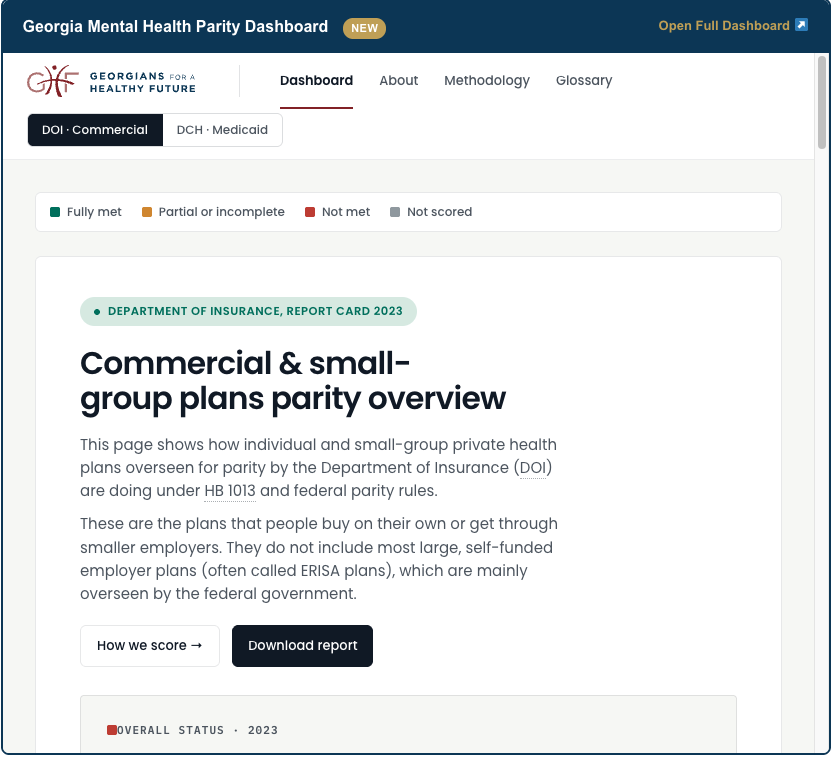 |
If your insurance covers a broken arm, it should cover therapy or addiction treatment at an equivalent level, without extra costs or barriers. That’s what Georgia’s 2022 Mental Health Parity Act requires. Four years later, many insurers still aren’t following the law. Georgians for a Healthy Future just launched the Georgia Mental Health Parity Dashboard, a free online tool that tracks how well or poorly insurers are providing fair mental health coverage. The dashboard rates 17 private health plans and 4 Medicaid and PeachCare plans using a simple red, yellow, and green system, so you can see how each insurance company measures up at a glance. The early picture is sobering. On the private insurance side, not a single one of the 17 plans reviewed is fully meeting parity standards. |
“The dashboard provides an in-depth look at how well insurers are living up to their mental health parity obligations. People deserve to know who isn’t complying with the law, and those companies should be held accountable. For too many Georgians, getting mental health and substance use treatment still depends more on what their insurer allows than on what their doctor recommends. Policymakers, health advocates, and the private sector must work together so every Georgian has access to essential health care and treatment.”
Whitney Griggs, Director of Health Policy, Georgians for a Healthy Future
See How Georgia’s Insurers Compare
The Georgia We Know Deserves Better

Amid an ongoing affordability crisis, Medicaid stands out as a rare example of health coverage that actually works, with little to no cost-sharing, no surprise bills, and reliable access to care. One in five Georgians is covered by Medicaid, including nearly half of our state’s children, 73 percent of nursing home residents, and the mothers of 42 percent of babies born in Georgia in 2024.
But federal cuts from H.R.1 and the expiration of enhanced marketplace subsidies are putting that coverage at risk. An estimated 32,000 Georgians are projected to lose Medicaid, average Georgia Access premiums have more than doubled, and Georgia hospitals and providers stand to miss out on $5.4 billion in federal funding through 2034. With Georgia already carrying one of the highest uninsured rates in the country and Pathways to Coverage reaching just under 15,000 enrollees, state inaction will only deepen the harm.
The good news: Georgia has real options. Expanding Medicaid alone could cover thousands of Georgians and bring billions of federal dollars back to our state. Cover Georgia’s latest blog breaks down what’s at stake, what state leaders can do, and how you can take action.
Has Health Coverage Gotten Harder to Afford? We Want to Hear From You.
|
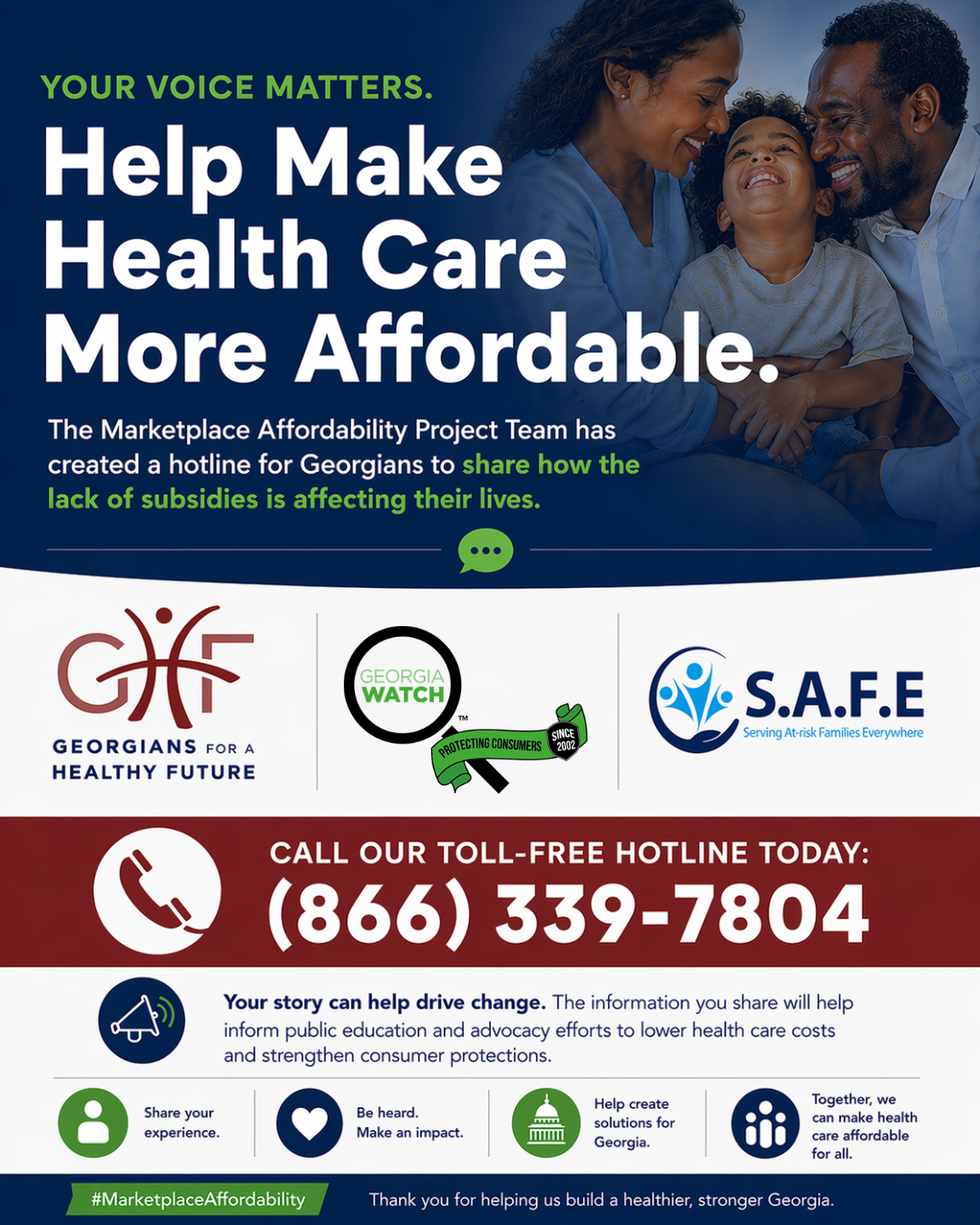
For a growing number of Georgians, keeping health insurance now means cutting back on groceries, skipping prescriptions, or dropping coverage altogether. When enhanced premium subsidies expired at the end of 2025, average monthly premiums on Georgia Access more than doubled, from $69 to $148. Media reports suggest that 500,000 Georgians have already disenrolled from coverage, primarily because of the cost. Lawmakers need to hear what that looks like in real life. GHF has teamed up with Georgia Watch and S.A.F.E. to launch the Marketplace Affordability hotline, a free, toll-free number where Georgians can share how rising premiums are affecting their families, their health, and their budgets. You can also submit your story in writing or on video. These experiences will shape our advocacy heading into the 2027 legislative session and help us push for real affordability solutions at the state level. If you or someone you know is struggling to afford health coverage, take a few minutes to share your story. 📞 Call (866) 339-7804 |
 |
Share Your Story in Writing or Video
The 2026 Legislative Session is a Wrap

The 2026 Georgia General Assembly is officially in the books. Lawmakers moved the needle on a number of health care issues this year, though key priorities for Georgia consumers were left undone.
The final FY2027 budget ended up as a compromise between the House and Senate on most health care priorities. Lawmakers funded 900 new NOW/COMP waiver slots for Georgians with intellectual and developmental disabilities, expanded the maternal home visiting program to 33 additional counties, maintained the Georgia Housing Voucher Program expansion, and doubled down on Medicaid rate increases for autism services. At the same time, the committee deepened cuts to the reinsurance program that helps stabilize premiums on Georgia Access, a concerning move as enrollment falls due to the expiration of federal enhanced premium subsidies.
Several measures that GHF supported crossed the finish line, including surprise ambulance billing protections (HB 506), a pathway for internationally trained physicians to practice in underserved areas (SB 427), over-the-counter access to PrEP (SB 195), and a Medicaid waiver for home and community-based mental health services (SB 428). Community health worker certification (HB 291), one of our top priorities, did not pass this session, but advocates and CHWs are regrouping to try again.
What happens now? Under Georgia law, Governor Kemp has 40 days after Sine Die, until May 12, to sign bills into law, let them become law without his signature, or veto them. He also holds line-item veto power over the budget, meaning any individual budget item could still be struck before FY27 begins on July 1. GHF will be watching closely.
There’s much more to unpack, from behavioral health workforce investments to rural hospital funding to what the final budget means for Georgia’s marketplace.
GHF in the News
Catch up on recent media coverage featuring GHF’s work, team, and storytellers:
|
WABE | February 5, 2026 New Georgia dashboard to track Mental Health Parity Act insurance violations |
|
Georgia Public Broadcasting | February 5, 2026 Advocates and enforcers agree abiding by parity laws saves taxpayer money, but who uses those funds? |
|
CNN | March 2, 2026 Hospitals are making cuts after ‘big beautiful bill,’ fueling Democrats |
|
Atlanta Business Chronicle | March 11, 2026 Three Atlanta health leaders recognized for advancing health equity |